
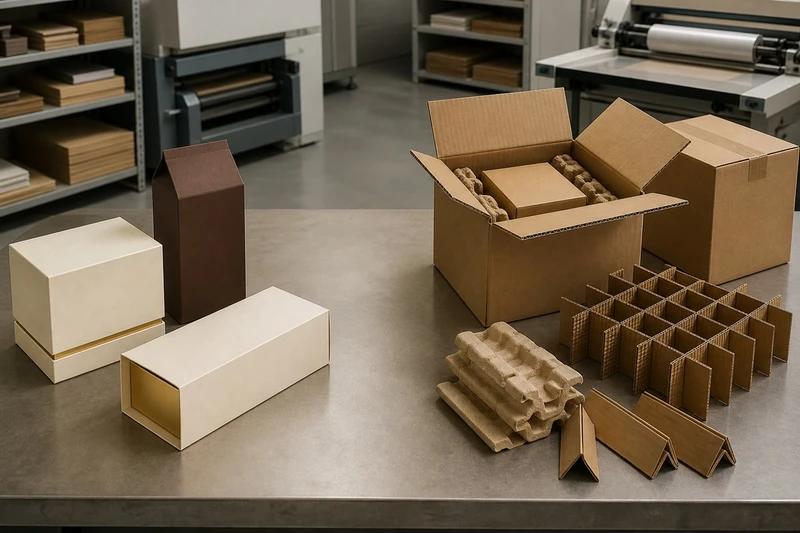
Retail packaging vs shipping packaging is not simply a choice between an attractive box and a strong one. Retail packaging is designed to present, inform and help sell the product, while shipping packaging is designed to protect the packed order through storage, handling and transport.
Many products need both. The most reliable approach is to design the retail pack around the product and customer experience, then select a transit solution that manages the actual delivery risks. For some compact, durable products, one well-designed mailer can perform both jobs. For fragile, premium or irregular items, separate retail and shipping layers are usually the safer choice.
Define primary, secondary and transit packaging
Packaging decisions become easier when each layer has a clear job. The same box may sometimes perform more than one role, but the requirements should still be assessed separately.
| Packaging level | Main purpose | Typical examples | Key design priorities |
|---|---|---|---|
| Primary packaging | Directly contains or protects the product | Sachet, bottle, food carton liner, cosmetic tube, jewellery pouch | Product compatibility, hygiene, containment, presentation |
| Secondary packaging | Groups, presents or adds protection around the primary pack | Printed product box, gift box, multipack carton | Branding, shelf display, product information, tamper evidence |
| Transit packaging | Protects goods during warehousing and delivery | Corrugated shipper, mailing box, protective wrap, pallet carton | Compression strength, impact protection, handling efficiency |
A skincare jar may sit in a primary container, be placed in a printed retail carton, then packed inside a corrugated delivery box with paper void fill. A T-shirt, by comparison, may be folded into a branded mailing box that acts as both secondary and transit packaging.
The important distinction is that the retail pack is viewed by the buyer before purchase or at unboxing, whereas the shipping pack is exposed to fulfilment processes and carrier handling. Designing one without considering the other can lead to damaged goods, unnecessary freight costs or a disappointing customer experience.
For branded product cartons, gift boxes and mailers, review the available custom box packaging formats against the product’s dimensions, weight and intended sales channel rather than choosing on appearance alone.
Separate shelf and delivery risks
Retail environments and delivery networks create very different risks. A retail box may look perfect on a shelf yet fail quickly once it enters an e-commerce fulfilment process.
Retail packaging must sell, inform and stay presentable
On a physical retail shelf, packaging competes for attention and must remain tidy after stocking, customer handling and merchandising. It may need to:
- Communicate the brand and product range quickly.
- Present required product details, warnings or instructions where applicable.
- Suit shelf dimensions, hooks, trays or point-of-sale displays.
- Resist scuffing, light crushing and repeated handling.
- Make the product easy to inspect without making it easy to damage or tamper with.
- Support premium cues through board choice, print, finishes, inserts or opening style.
Retail packs are often optimised for a front-facing panel, visual consistency and efficient shelf replenishment. They are not automatically designed for drops, conveyor impacts or stacked courier cages.
Shipping packaging must manage variable handling conditions
Transit packaging needs to protect the product through picking, packing, loading, delivery and return handling. It should account for conditions that can vary from one order to the next:
- Drops, knocks and vibration during sorting and transport.
- Compression from cartons stacked above.
- Moisture exposure, especially during wet weather or doorstep delivery.
- Abrasion between parcels and movement inside the carton.
- Long transport distances between fulfilment centres and customers.
- Multiple handling points when an order moves through carrier networks.
Australian deliveries can involve substantial distances, changing weather conditions and a mix of metropolitan and regional routes. That does not mean every parcel needs maximum protection. It does mean packaging should be tested for the actual journey rather than an idealised short trip.
The common mistake: treating a retail carton as a shipper
A printed folding carton is often suitable as secondary packaging but may not have enough structural strength to act as the only delivery pack. If it has large panels, a loose lid, heavy contents or a delicate finish, it can crush, split or scuff during shipping.
Conversely, using an oversized plain shipper as the only customer-facing pack can protect the item but waste material, raise dimensional freight charges and weaken the unboxing experience.
The better question is: what risks does the product face before the customer opens it, and which packaging layer should control each risk?
Decide when one pack can do both jobs
A single pack can work as both retail and shipping packaging when the product is reasonably robust, the box is appropriately sized and the expected delivery conditions are understood. This is commonly called a ship-ready, e-commerce-ready or direct-to-consumer pack.
It can simplify fulfilment because the team packs the product once rather than placing a retail box inside another carton. It may also reduce material use and storage complexity. However, it should not be chosen solely to eliminate a packaging layer.
One box is often suitable when
A combined retail and shipping box may be practical if most of the following apply:
- The product is light to moderate in weight.
- The product does not break easily under ordinary impacts.
- The product fits closely within the box.
- The pack can use built-in protection, such as a snug insert or internal divider.
- The outer surface can tolerate scuffs, labels and handling.
- The opening and closing design remains secure through delivery.
- The item is sold primarily through e-commerce, rather than needing a high-impact retail shelf presence.
- A carrier label can be applied without obscuring essential branding or information.
Examples may include apparel, stationery, robust accessories, some subscription products and certain non-fragile gift items.
Separate layers are usually better when
Use a retail pack inside a dedicated shipping pack when the product has a high likelihood of damage, a premium finish or different retail and logistics requirements. This applies especially to:
- Glass, ceramics and other breakable products.
- Heavy items that can burst through a lightweight presentation box.
- Products with sharp edges, moving parts or awkward shapes.
- High-value gift packaging that must arrive without dents or scuffs.
- Products that need retail-ready display trays, hang tabs or windows.
- Orders containing several separate products.
- Items requiring temperature, moisture or contamination controls.
- Packs that may be returned and sent again.
A separate transit carton creates a sacrificial protective layer. It can collect labels, abrasions and minor handling damage while preserving the retail box inside.
Use a decision matrix before committing
Before approving a combined design, rate the product and journey against these questions:
- Product fragility: Can it withstand a short drop or compression without damage?
- Pack fit: Is there enough room for protective features without excessive empty space?
- Product weight: Will the contents strain the board, seams or closure?
- Surface sensitivity: Can printed finishes withstand rubbing and labels?
- Sales channel: Is the pack primarily for a shelf, an online order or both?
- Return likelihood: Will it need to be resealed and shipped back?
- Order configuration: Is the product shipped alone, in multiples or with other items?
- Freight efficiency: Does the external size create avoidable dimensional weight?
If the answers reveal competing priorities, a two-pack system is often more cost-effective than replacing damaged stock or managing customer complaints.
Plan void space, seals and returns
A strong shipping box alone is not enough. The product must be stable inside it, the closure must remain intact and the recipient should be able to open the parcel without damaging the item or creating an unnecessarily frustrating experience.
Match the box closely to the packed product
Void space is the area between the product and the outer carton. Some space is needed for protective material, but too much allows the contents to move and increases the external carton size.
Excess void space can lead to:
- Product collision with carton walls.
- Crushed corners when the box is compressed.
- Higher material consumption.
- Larger freight charges where cubic or dimensional measures apply.
- An unboxing experience that feels wasteful or poorly considered.
Measure the fully packed product, not just the item itself. Include the primary pack, retail carton, inserts, protective material and any accessories. Then allow only the clearance needed for an effective protective system.
Choose void fill for the product, not visual effect
Void fill should stop movement and absorb expected impacts. Suitable options vary by product:
- Die-cut inserts: Useful for repeatable product positioning and premium presentation.
- Corrugated dividers: Helpful for separating bottles, jars or multiple items.
- Paper cushioning: Suitable for many non-fragile products and flexible order sizes.
- Protective wraps or sleeves: Useful for surface-sensitive or breakable goods.
- Moulded inserts: Can secure complex shapes where consistent positioning matters.
Do not rely on decorative tissue alone to protect a heavy or fragile item. It may enhance presentation, but it is not necessarily a structural cushioning material.
Design the seal around the shipping reality
The closure method must suit how the pack is filled, transported and opened. A tuck flap may be adequate for an internal product carton but may not remain closed when used as a shipping box. Tape, adhesive strips, locking tabs or tear strips each have different practical trade-offs.
Check:
- Whether the closure remains secure under normal handling.
- Whether packers can close it consistently and quickly.
- Whether the seal creates a tamper-evident cue where needed.
- Whether the customer can open it without tools or excessive force.
- Whether the closure can be used again for a return.
For direct-to-consumer orders, a dual-seal design can be useful: one seal for the original delivery and another for the customer to reseal the pack if a return is required. Confirm that the return method suits your operational process; not every product or order type needs return-ready packaging.
Make returns part of the original brief
Returns are often overlooked during packaging development. If customers may send products back, assess whether the original packaging can safely carry the item on a second journey.
A return-capable design may include:
- A resealable strip or spare closure area.
- Clear opening points that do not destroy the structure.
- Space for a return label or instructions.
- Protection that can be repacked without specialist tools.
- A layout that keeps the retail product carton intact.
There is a trade-off: a more complex return-ready pack may cost more than a standard shipper. It is most worthwhile where products are regularly returned, high in value or difficult to repack safely.
Test the full packed system
Packaging should be tested as a system: product, primary pack, secondary box, protective components, shipper and closure. Testing an empty carton tells you little about whether the actual order will survive delivery.
Test the real product configuration
Build samples using the final or closest available versions of:
- The product and all accessories.
- Retail packaging and inserts.
- Transit carton.
- Void fill and separators.
- Tape, adhesives, labels and seals.
- Any documents, promotional cards or return materials.
Test the heaviest, largest and most fragile product variants, not only the easiest configuration. If customers order bundles, test a realistic multi-item order as well.
Include likely handling stresses
An internal packaging review should consider the stresses likely to occur during fulfilment and delivery:
- Short drops onto different faces, edges and corners.
- Vibration or movement caused by transport.
- Stacking pressure.
- Repeated handling.
- Moisture exposure where relevant.
- Abrasion to printed surfaces and corners.
- Opening and resealing by a typical customer.
Formal transport testing may be appropriate for sensitive, heavy or high-volume products. If you use a third-party testing standard or laboratory, confirm the exact method, pass criteria and product configuration. A test result only applies to the pack configuration that was actually tested.
Assess more than breakage
A parcel can arrive with an unbroken product yet still fail as customer packaging. During evaluation, inspect for:
- Dents, bowing, split seams and crushed corners.
- Product movement inside the box.
- Broken seals or lifting adhesive.
- Scuffed print, damaged coatings or torn labels.
- Difficulty opening the package.
- Packaging waste that seems excessive for the product.
- Whether the product can be repacked for a return.
Record failures by packaging layer. For example, a damaged retail carton inside an intact shipper suggests insufficient internal clearance or cushioning; a burst shipper may point to box strength, closure design or product weight distribution.
Balance brand experience with logistics
Brand experience and logistics are not opposing goals. The best packaging designs assign each element a useful role: protect the product, make fulfilment efficient and create a considered opening moment.
Start with the non-negotiables:
- Product dimensions, weight and fragility.
- Sales channel and order configuration.
- Retail display needs, if applicable.
- Fulfilment workflow and pack-out speed.
- Carrier handling exposure.
- External size limits and freight efficiency.
- Customer opening and return expectations.
- Brand presentation requirements.
Then decide where to invest in visual detail. A premium retail box can be protected by a simpler outer shipper. Alternatively, a branded mailing box may deliver a strong unboxing experience without requiring a separate gift carton. The right option depends on the product, not on a universal packaging trend.
Practical ways to protect the experience without overpacking
- Put high-value printing and finishes on the retail or inner layer when the outer shipper will receive labels and scuffs.
- Use right-sized cartons before adding more filler.
- Design inserts to hold the item in place, rather than using large volumes of loose material.
- Keep opening instructions obvious, particularly for tear strips and resealable closures.
- Reserve premium embellishments for surfaces customers will see in good condition.
- Standardise a small range of shipping carton sizes where possible to simplify fulfilment.
- Review packaging whenever product dimensions, order mix or carrier arrangements change.
A low-cost box that causes slow packing, higher freight charges or damaged products is not necessarily economical. Equally, a highly decorative pack that adds little product protection may not justify its complexity. Consider the total system cost: materials, labour, storage, freight, damage, returns and customer perception.
FAQ
Is retail packaging the same as product packaging?
Not always. Product packaging can refer broadly to any packaging around the item. Retail packaging usually describes the customer-facing pack designed for shelf presentation, product information and brand communication. It is commonly a secondary packaging layer, though this varies by product.
Can a mailer box be used as retail packaging?
Yes, particularly for e-commerce-first products. A mailer can serve as both a branded presentation box and a transit pack when it fits the product closely, has adequate structural protection and can withstand the planned delivery journey. Fragile or premium products may still need an internal retail pack or protective insert.
Should every retail box be placed inside a shipping box?
No. A separate shipping box is most useful when the retail carton is not strong enough for transport, the product is fragile, the finish is sensitive, or the order contains multiple items. Durable products in a well-designed mailing box may not need another outer layer.
How much empty space should be left in a shipping box?
Leave only enough space for the protection the product needs. There is no universal measurement because the right clearance depends on weight, fragility, cushioning material and box strength. The packed product should not shift noticeably when the sealed carton is gently moved.
What should be tested before a packaging launch?
Test the final packed order for movement, drops, compression, closure performance, print scuffing, opening, resealing and return packing. Repeat the assessment across the full product range and common order combinations.
The practical choice in retail packaging vs shipping packaging is to give each package layer a defined job, then test the complete order under realistic conditions. If you are specifying a new box range, prepare a brief with product measurements, weight, sales channels, pack-out process and expected delivery format. XGolden Print can then help translate those requirements into suitable custom packaging options.
