
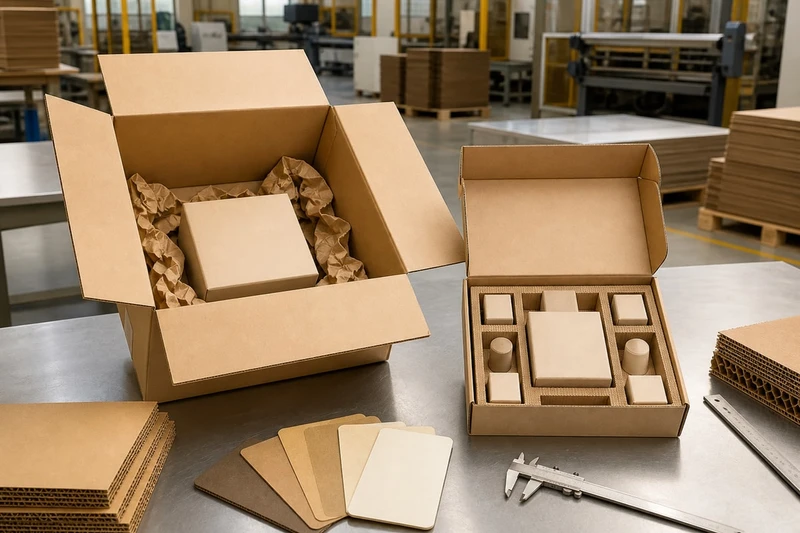
To reduce packaging void space without increasing damage risk, design the carton, insert and packing method as one system. Start with the product in its final packed state, allow space only for the protection it actually needs, and use fitted retention rather than filling empty volume with loose materials.
The aim is not to make every parcel as small as possible. It is to limit uncontrolled movement, protect vulnerable features from impact and compression, and give packers a repeatable process. A well-designed pack may still include deliberate clearance around a fragile or temperature-sensitive product—but that clearance should be supported by an appropriate protective structure.
Measure the complete packed product
The most common cause of excess void space is sizing a box around the product alone. The correct starting point is the complete packed product: the item plus any primary pack, accessories, labels, protective wrap, instructions and components that travel in the same carton.
Measure this complete unit in the orientation in which it will be packed. Record:
- Length, width and height at the widest points
- Product weight and weight distribution
- Protrusions, handles, caps, corners and fragile edges
- Whether the product has a preferred upright orientation
- The dimensions of accessories and printed collateral
- Variations between product sizes, batches or seasonal bundles
- The thickness and compression behaviour of existing protective materials
For irregular products, do not rely on a single ‘average’ measurement. A bottle with a shoulder, a shaped cosmetic jar or an electronics component with a cable may occupy more practical packaging space than its nominal dimensions suggest. Photographing the packed item from several angles can also help packaging suppliers understand the retention challenge.
Calculate the protection allowance
After measuring the product, add a protection allowance based on its handling risks—not an arbitrary gap on every side. For example:
- A robust folded garment may need only enough clearance to prevent crushing and allow easy packing.
- A rigid gift box may need edge protection to avoid scuffing and corner damage.
- A glass product may require cushioning around the body, restraint at the neck or base, and separation from other items.
- A multi-item kit may need dividers to stop components striking each other.
This distinction is important. Empty space alone is not protection. In many cases, a smaller outer carton with a correctly shaped insert is safer than a larger carton packed with a generous amount of loose fill.
Check dimensional weight implications
For e-commerce and national freight shipments, carton dimensions can influence freight charges as well as material use. Reducing unnecessary external dimensions may improve storage density and reduce the volumetric footprint of a shipment. However, do not reduce dimensions until the protective system has been validated.
A carton that is too tight may crush under stacking, transfer impact directly to the product or create packing inconsistencies. The best result balances external dimensions, material use, product protection and labour at the packing bench.
Identify movement and impact risks
Before selecting an insert or changing box dimensions, identify what can go wrong during packing, handling and transport. This avoids the mistake of using the same void-reduction method for every product.
Ask these questions:
- Can the product move inside the pack?
Test movement in all directions, not only side to side. Movement towards the top of the carton can be damaging when a parcel is dropped or stacked.
- Which parts are vulnerable?
Corners, screens, closures, glass edges, dispensing pumps, decorative finishes and printed surfaces often need more protection than the main body.
- What forces might the carton experience?
Consider drops, vibration, compression in stacked loads, parcel handling and changes in orientation.
- Will several products share one carton?
Products should be separated when contact could cause breakage, scuffing, leakage or tangling. A divider, tray or dedicated cavity may be more effective than loose void fill.
- How will the package be packed and opened?
A highly precise insert may minimise empty space but be too slow for high-volume packing or difficult for customers to remove. The pack must work in real conditions.
- Does the product change during storage or transit?
Some products need room for an outer protective bag, a tamper seal, a temperature-control component or a change in pack configuration. Confirm these requirements early.
Match protection to the risk
Protection should restrain the product where needed while allowing the outer carton to absorb handling forces. Different risks call for different solutions:
| Primary risk | Suitable approach | Key check |
|---|---|---|
| Product slides in transit | Fitted tray, end caps, wrap or cavity insert | Product cannot shift after the carton is closed |
| Two items collide | Divider, partition or separate compartments | Adequate separation remains under compression |
| Fragile edges or corners | Corner protection, moulded insert or cushioning pads | Vulnerable points do not contact the carton wall |
| Surface scuffing | Tissue, paper wrap, sleeves or coated insert | Materials do not abrade or transfer colour |
| Heavy product breaks through base | Stronger outer structure with base support | Carton and insert support weight during handling |
| Awkward product shape | Custom die-cut insert or formed tray | Retention is consistent in the intended orientation |
Avoid assuming that a material is protective because it feels soft. Its performance depends on thickness, density, placement, compression behaviour and whether it remains in position around the product.
Right-size the outer structure
Right-sizing means choosing an outer carton that accommodates the product and its required protective components with minimal uncontrolled space. It does not mean forcing the product into the smallest possible box.
Begin with the internal dimensions needed for the packed system. Then select an outer structure with suitable board strength, closure design and panel layout for the product’s weight and handling conditions. Confirm dimensions as internal or external when comparing specifications; confusion between the two can lead to cartons that do not fit the intended insert.
For retail-ready packaging, also consider shelf presentation, product visibility, barcodes, opening features and how cartons fit into master shippers. A retail box can be closely sized for presentation while a separate transit carton provides additional protection for delivery.
Use one box size only when it genuinely fits
Standardising on one carton size can simplify purchasing and warehouse storage, but it often creates high void space for small orders or product variants. Consider a small range of compatible carton sizes when products vary substantially.
A practical approach is to create packaging tiers, such as:
- A compact carton for single small products
- A medium carton for bundles or a larger product format
- A dedicated carton for high-value, fragile or unusually shaped items
The added complexity must be weighed against savings in materials, packing time, freight volume and damage reduction. If a range of sizes is used, clear packing instructions and visual identifiers help prevent staff from choosing the wrong carton.
Design for packing tolerance
Products and inserts are not perfectly identical in every production run. Include realistic tolerances for product variation, board thickness, folds, coatings and assembly. An extremely tight fit can become unreliable if a product label is slightly thicker, a folded carton sits differently, or a packer needs to place an item quickly.
A good packaging specification states:
- Product orientation
- Required clearance or cushioning zones
- Insert position and fold sequence
- Any components to be packed before or after the product
- Closing method and any tamper-evident requirement
- Acceptable movement after assembly
These instructions turn void-space reduction into a repeatable packing process rather than a result that depends on individual judgement.
Replace loose fill with engineered retention
Loose fill can be useful for some irregular product mixes, but it often creates inconsistent results. It can settle during transit, make packing slower, obscure whether the product is correctly positioned and add unnecessary material when used to compensate for an oversized carton.
Engineered retention controls product position through a designed feature: an insert, tray, divider, sleeve, wrap, pad or shaped cavity. It is usually the most effective way to reduce packaging void space while maintaining protection.
Compare common void-reduction options
| Solution | Best suited to | Advantages | Limitations to review |
|---|---|---|---|
| Die-cut cardboard insert | Gift boxes, bottles, retail products and kits | Can retain products precisely; supports branding and a cohesive unboxing experience | May require more design work; fit depends on accurate product dimensions |
| Folding partitions | Multi-item packs, jars, bottles and components | Separates items and can pack flat before use | Needs suitable carton size and sufficient vertical support |
| Paper cushioning or wrap | Light to medium-weight products with variable shapes | Flexible, easy to adapt and useful for surface protection | Can shift if not packed tightly or used with an oversized carton |
| Pulp or formed fibre tray | Products needing shaped support | Good retention and can protect key contours | Tooling, fit and product variation need careful consideration |
| Foam insert | Delicate or high-value products requiring cushioning | Can provide tailored support and impact cushioning | Material selection, disposal expectations and pack presentation should be assessed |
| Corrugated pads and end caps | Products needing edge, end or base protection | Simple, robust and suitable for many transit applications | May not prevent lateral movement without other retention |
| Shrink film, bands or sleeves | Bundled goods or boxes within a shipper | Holds grouped items together | Does not replace cushioning where impact protection is needed |
The right choice depends on the product’s fragility, weight, shape, order configuration, presentation needs and pack-out process. A customised insert can reduce both void space and packing variability, while flexible paper-based cushioning may suit operations that ship mixed baskets with changing contents.
For products that are presented in a premium retail or gifting format, a fitted insert can also prevent the ‘rattle’ that makes a pack feel poorly specified. Explore custom packaging boxes when the carton and insert need to be developed as a coordinated presentation and protection system.
Keep void fill where flexibility matters
Engineered retention is not always the only answer. Loose or flexible void fill can be appropriate when:
- Orders contain changing combinations of products
- Product dimensions vary significantly
- Low-volume dispatch does not justify dedicated inserts
- The product is robust but needs protection from surface rubbing
- A single fulfilment carton must accommodate several configurations
In these cases, reduce the carton size first, then define the amount and placement of fill required. Tell packers where it goes: below the item, around the sides, over the top or between items. “Add void fill as needed” is too vague to deliver consistent protection.
Review material and assembly trade-offs
Reducing empty space can introduce trade-offs. The ideal package is not simply the one with the least material or the tightest fit; it is the one that protects the product reliably while remaining sensible to produce, pack, transport and open.
Balance materials against labour
A multi-part insert may use less loose fill and create a neater pack, but it can take longer to assemble. Conversely, a pre-glued tray may be faster at the packing bench but occupy more storage space before use.
Review each option against:
- Material quantity and format
- Flat-packed versus pre-assembled storage
- Assembly steps and training needs
- Packing speed and error risk
- Compatibility with hand packing or existing fulfilment workflows
- Product presentation at opening
- Separation of different material types, where relevant to disposal pathways
- Ability to accommodate future product updates
For smaller runs or variable orders, a simpler corrugated insert and paper wrap may be more practical than a highly complex tray. For repeat, high-volume packs, a purpose-designed insert can improve consistency enough to justify its setup and assembly requirements.
Avoid over-engineering
A complex insert is not automatically better. Over-engineering can add cost, slow packing and frustrate customers, especially where the product is durable and simple to pack.
Use the least complex system that manages the actual risks. For example:
- Use a folded divider rather than individual cavities when bottles only need separation.
- Use a top pad and base support instead of a full tray when the product is stable but needs vertical cushioning.
- Use a properly sized mailer rather than a carton plus multiple fillers for a lightweight, non-fragile item.
- Use product-specific retention for fragile items rather than increasing loose fill around an oversized box.
The protection system should also allow a packer to see whether the product has been placed correctly. Hidden errors—such as a bottle sitting outside its cavity or a leaflet obstructing a closure—can undermine an otherwise well-designed pack.
Validate the packed system before production
Never approve a void-reduction change from a drawing alone. Assemble representative samples with the actual product, all components and the intended packing method. A design that looks efficient on screen may be difficult to fold, leave too little clearance, or behave differently once the carton is closed.
Validation should test the complete packed system, including outer carton, insert, closures, labels and internal components.
Run practical checks
At a minimum, review:
- Fit: Does every component fit without forcing, excessive slack or distortion?
- Movement: Does the product rattle, rotate or shift when the closed pack is gently moved?
- Closure: Can the carton close properly without bulging, crushing the product or straining the tabs?
- Retention: Does the product stay in its intended position after turning the pack through different orientations?
- Packing process: Can staff assemble and pack it correctly using clear instructions?
- Unpacking: Can the recipient remove the product without tearing the pack or applying unsafe force?
- Appearance: Does the package retain its intended retail or gifting presentation after normal handling?
- Stacking: Does the outer structure remain stable when packed units are stacked in the expected way?
Where the product is fragile, high-value, heavy or likely to face demanding distribution conditions, use an appropriate transport test plan that reflects your actual supply chain. The required method, sample quantity and pass criteria will vary by product and distribution channel. Define these before committing to production, rather than treating testing as an afterthought.
Test worst-case combinations
Do not test only the easiest example. Include realistic worst cases, such as:
- The heaviest product variant
- The thickest label or outer wrap
- A full kit with all accessories
- A carton assembled by a new packer using the written instructions
- Products packed near the limits of dimensional tolerance
- A pack that has been stored before shipping
If the pack relies on a particular product orientation, make that orientation obvious through the structure, graphics or packing instruction. A system that only works when packed perfectly but gives no guidance is vulnerable to failure in routine operations.
Record the approved pack-out
Once validated, document the approved configuration with dimensions, materials, dielines, component list, assembly images and inspection points. This record is useful when reordering, onboarding packers, changing a product component or comparing future samples.
Common changes that should trigger a review include a new bottle shape, revised label, heavier accessory, altered closure, different wrap thickness or a change in shipper configuration. Even small changes can affect fit and void space.
Common mistakes when reducing packaging void space
Several shortcuts can reduce carton volume while increasing product risk:
- Measuring the bare product instead of the finished packed item
- Using a smaller carton without adding retention
- Filling every gap tightly enough to transfer impact directly to the product
- Assuming loose fill will stay evenly distributed in transit
- Ignoring product orientation and weight distribution
- Choosing an insert based on appearance rather than actual fit
- Creating a pack that is too difficult or slow to assemble
- Approving samples without testing the intended contents and packing process
- Treating all product variants as identical when their dimensions differ
The solution is usually not more material. It is better control over the space that remains.
FAQ
How much empty space should be left in a shipping box?
There is no universal amount. Leave enough room for the protective material and clearance required by the product’s weight, fragility, shape and transport conditions. The key measure is whether the product is restrained and protected, not the percentage of empty volume.
Is loose fill bad for packaging?
No. Loose fill and paper cushioning can be practical for variable product combinations or irregular shapes. It becomes less effective when used as a substitute for a properly sized carton or when it allows products to settle and move during transit.
Can a fitted insert replace the outer shipping carton?
Usually not for products that will move through parcel networks. A fitted retail insert may protect presentation and stop movement inside a gift box, while an outer transit carton provides added resistance to handling and stacking forces. Assess both layers together.
What is the best packaging material for reducing void space?
The best material depends on the product and process. Die-cut board inserts work well for repeatable product shapes and branded presentation; partitions separate multiple items; paper cushioning suits variable orders; formed trays or foam may suit products that need shaped cushioning. Validate the complete system before deciding.
Reducing void space begins with accurate measurement and ends with a tested packing method. If you are specifying a new box or reviewing an existing pack, prepare a product sample, component list, dimensions and packing sequence first—then compare outer-carton and insert options against the real handling risks.
