
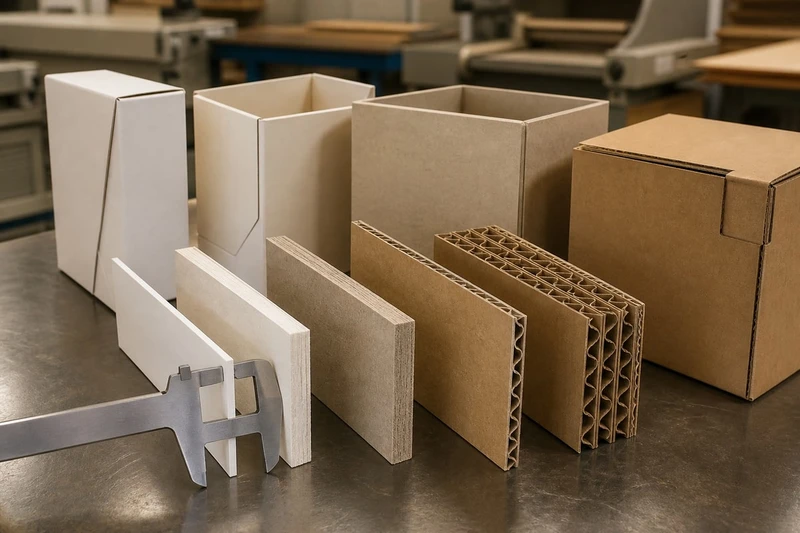
Paperboard thickness and box strength are connected, but thickness alone does not tell you whether a box will protect a product. A thicker board may feel more substantial in the hand, yet a lighter board with stronger fibres, suitable folds and a better structural design can perform more reliably for the same application.
For a useful comparison, assess grammage, caliper, board grade, fibre composition, box construction, product load and the conditions the pack will face. The right specification is the one that performs in your actual supply chain—not simply the board with the highest number on a quote.
Separate grammage, caliper and board grade
These terms are often used interchangeably in packaging discussions, but they measure different things. Treating them as the same can lead to boxes that look right in a sample room but crease, bow or crush in use.
Grammage measures mass per area
Grammage is the mass of paperboard per square metre, expressed as g/m² (gsm). It is useful for comparing material use and often influences stiffness, opacity and feel.
However, a higher gsm does not automatically mean a stronger box. Two boards at 350 gsm can differ considerably because their fibres, coatings, bulk and manufacturing process are different.
For example, a denser board may have a lower caliper than a bulkier board of the same grammage. One may be better suited to fine printing and crisp folding, while the other may provide a more rigid presentation pack.
Caliper measures physical thickness
Caliper is the board’s measured thickness, commonly stated in microns (µm) or millimetres. It affects how substantial a box feels, how it folds, how it runs through converting equipment and how much material is needed at score lines and joints.
Caliper matters especially for:
- Rigid-looking folding cartons for premium retail shelves
- Deep boxes with broad panels that may bow
- Boxes carrying heavier contents
- Designs with large tuck flaps or locking tabs
- Packaging where a firm, tactile feel is part of the brand experience
A caliper reading alone is still not a performance guarantee. Board can be thick because it is bulky, while another, thinner sheet may have greater stiffness or better resistance to repeated folding.
Board grade describes the material’s composition and intended properties
Board grade gives more practical context than gsm or caliper alone. It generally reflects the fibre mix, layer structure, surface treatment and the balance between print quality, stiffness, foldability and cost.
Common categories buyers may encounter include:
| Board type | Typical characteristics | Often considered for |
|---|---|---|
| Solid bleached sulphate (SBS) | Bright, smooth printing surface; often clean-cut and suitable for detailed graphics | Cosmetics, personal care, retail cartons and presentation packs |
| Folding boxboard (FBB) | Multi-layer board that can offer useful stiffness at a relatively low weight | Folding cartons, food-related packaging where the appropriate specification is selected, and consumer goods |
| Solid unbleached sulphate (SUS) or kraft board | Natural brown appearance, strong virgin fibres and a less refined visual finish | Natural-look brands, heavier retail packs and durable cartons |
| Recycled paperboard or chipboard | May offer good bulk and a recycled-content appearance; surfaces and consistency vary by grade | Secondary packaging, sleeves, inserts and applications where the selected grade suits the product |
| Coated or speciality boards | May add visual, tactile or barrier-related properties depending on construction | Premium cartons, gift packaging and designs with specific surface requirements |
Names and properties differ by manufacturer, so ask for the actual material specification rather than assuming every board sold under a broad category performs identically.
Fibre structure influences stiffness and durability
Virgin fibres are generally longer than recycled fibres, which can affect tear resistance, stiffness and performance around folds. Recycled-content boards can still be appropriate for many cartons, but their properties should be assessed against the intended use rather than judged by appearance alone.
Multi-ply boards also use fibre layers strategically. A board may have fibres and coatings arranged to create a smooth print face, a strong internal layer or a reverse side with a different finish. This construction affects how the board scores, creases and resists deformation.
When comparing quotes, ask suppliers to state:
- Board grade and mill or manufacturer specification, where available
- Grammage and nominal caliper
- Whether the stated thickness is a target, average or tolerance range
- Coating, laminate, varnish or other surface finish
- Fibre composition where it is relevant to the brief
- Which side is intended for printing and which side faces the product
Match board to product load and box style
The board must suit both the product’s weight and the way that weight is transferred through the carton. A 200 g item can be demanding if it is concentrated in a small area, has hard edges or moves inside the pack. Conversely, a larger but lightweight product may need broad panels that remain flat and visually neat.
Start with the product rather than a preferred gsm.
Assess the real load, not just product weight
A useful product-load review includes:
- Net product weight — the content placed in one carton.
- Weight distribution — whether the load is even, bottom-heavy or concentrated at corners.
- Product shape and edges — hard, sharp or angular products can stress board and seams.
- Movement within the carton — loose contents can repeatedly impact panels and closures.
- Added components — inserts, leaflets, pumps, glass containers, accessories and seals all change the load.
- Multipack configuration — cartons may be bundled, shrink-wrapped or packed together in a shipper.
- Use after purchase — gift boxes, reusable packs and display cartons may be opened and closed many times.
A product that puts force directly on the carton bottom needs more than a heavier board. It may need a different base design, a support insert, stronger glue areas or a structure that distributes the load.
Choose the box style before selecting a final board
Box geometry has a major influence on apparent and actual strength. The same board can behave very differently in a shallow tuck-end carton, a tall narrow pack, a sleeve or a folding gift box.
| Box style or feature | Key strength consideration | Practical check |
|---|---|---|
| Straight or reverse tuck carton | Tuck flaps, side seams and bottom panels carry the load | Confirm that closure tabs stay engaged after filling and handling |
| Auto-lock or crash-lock base | The base must lock squarely and support the product | Test with actual contents, particularly for dense or fragile products |
| Sleeve | Long panels can flex, while open ends leave contents less contained | Check fit over the inner pack and resistance to scuffing |
| Two-piece gift box | Lid fit, corner strength and tray rigidity affect presentation | Test repeated opening, stacking and removal from outer packaging |
| Window carton | The cut-out removes board and may weaken a panel | Review window size, placement and film attachment method |
| Display-ready or hanging pack | Panel shape and hanger area concentrate stresses | Assess tear risk at hang holes, locking points and shelf loading |
For e-commerce shipments, distinguish the retail carton from the transport packaging. A folding carton may be designed for product presentation, while an outer mailer or corrugated shipper manages distribution impacts. Expecting a retail carton to perform as a standalone freight box can result in unnecessary board cost or avoidable damage.
If you are specifying an outer carton rather than a folding carton, corrugated board should be evaluated using its own construction measures, such as flute profile, liner quality and edge-crush performance. Paperboard gsm and caliper are not enough to compare corrugated shipping boxes.
Consider folds, grain and converting
A box has to survive being converted from a flat printed sheet into a finished pack. The most suitable board is not always the thickest option; it must also score accurately, fold cleanly and hold its shape through packing.
Grain direction affects fold behaviour
Paperboard fibres tend to align predominantly in one direction during manufacture. This is known as grain direction. Board generally bends more readily in the grain direction and resists bending more across the grain.
Grain orientation can influence:
- The smoothness of folds and creases
- Panel stiffness
- Curl tendency
- The performance of narrow tabs and locking features
- How a carton springs open after folding
- The appearance of cracks in printed or coated areas
For cartons with prominent folds, discuss grain direction early in dieline development. A supplier may need to orient the artwork and layout to support the most critical creases. This can affect sheet utilisation, so it is best treated as a packaging-performance decision, not an afterthought.
Scoring must be appropriate to the board
A score creates a controlled crease line. If it is too shallow, thick or stiff board may crack, resist folding or cause an uneven carton shape. If it is too aggressive, it can weaken the panel, show through the print or create an untidy edge.
Watch carefully for:
- Cracking along dark ink coverage or metallic finishes
- Delamination at folds
- White stress marks on coated surfaces
- Uneven side seams due to poor folding
- Tabs that split or fail to lock
- Bulging panels caused by poorly positioned scores
Finishes can change converting behaviour. Lamination, heavy ink coverage, foil, embossing and some coatings may make folds less forgiving. A board specification should therefore be assessed with the intended artwork and finishing treatment, not as an unprinted sheet only.
Adhesives, tabs and cut-outs need enough material
Structural weak points are often not broad box panels; they are small areas around a glue flap, locking tab, hanger hole or perforation. Increasing gsm may help in some cases, but changing the structure can be more effective.
For instance, a wider glue area, a revised locking mechanism or a repositioned cut-out may address the issue without upgrading the full board specification. Ensure any adhesive choice is suitable for the surface finish and packing process, as coated or laminated surfaces can affect bonding.
Review stacking, handling and storage
Packaging encounters far more than its own product weight. It may be stacked in a warehouse, handled by fulfilment teams, placed in retail displays or stored in changing conditions before it reaches the customer.
Consider compression from stacking
Bottom cartons in a stack carry the weight of cartons above them. Compression can lead to panel bowing, softened corners, collapsed lids or damaged contents.
To assess stacking exposure, establish:
- How many filled packs may be stacked
- Whether packs are stacked directly or placed in trays
- Whether the stack is stable and square
- How long products may remain stacked
- Whether outer cartons share the load
- Whether pallets, retail displays or storage shelves create additional pressure
A carton that looks firm when individually handled may not retain its shape under sustained compression. This is particularly relevant for taller cartons, large flat panels and boxes with loose-fitting lids.
Humidity and temperature can change board behaviour
Paperboard is hygroscopic: it absorbs and releases moisture from the surrounding air. Changes in humidity can affect stiffness, curl, dimensions and folding behaviour. Storage conditions, long warehouse dwell times and transport routes can therefore influence performance.
The practical response is not to assume that one board will behave identically in every setting. Confirm how finished packaging should be stored, keep packs protected from avoidable moisture exposure, and test when conditions are likely to be demanding.
Handling damage can be cosmetic or structural
Scuffing, corner compression and abrasion may not make a box unusable, but they can still undermine shelf presentation. This is important for premium retail and gift packaging.
Review:
- How cartons are packed into outer cases
- Whether there is room for packs to shift during transit
- Contact between printed faces
- The risk of rubbing against inserts or product components
- Whether cartons are hand-packed or machine-packed
- The amount of handling before retail display
Surface protection, pack orientation and outer-case design may solve a handling issue more effectively than selecting a thicker board.
Avoid unsupported strength assumptions
The most common procurement mistake is to treat a single number—usually gsm or thickness—as proof of box strength. It is not.
Avoid assumptions such as:
- “A higher gsm carton will always carry more weight.”
- “A thicker board will always be stiffer.”
- “Virgin-fibre board is automatically right for every application.”
- “A premium finish will not affect creasing.”
- “If the flat sample feels strong, the assembled box will perform.”
- “A retail carton can replace a shipping pack.”
- “A previous specification will work after the product, dimensions or finish changes.”
Board performance is application-specific. A change as small as increasing box height, adding a window, changing from a light jar to a glass bottle, or moving the score line can alter the result.
Do not claim a board is “strong enough” unless the relevant box design, contents and handling conditions have been considered. If measurable performance is critical, agree on what is to be tested and what acceptable outcome looks like. That might include closure retention, fold appearance, load support, compression resistance, abrasion tolerance or packed-product protection.
Confirm performance with representative samples
A representative physical sample is the most practical way to reduce uncertainty before committing to a full production run. It should be close to the proposed final pack, not merely an empty mock-up made from different material.
What a representative sample should include
Where possible, assess a sample with:
- The intended board grade, grammage and caliper
- Final box dimensions and dieline
- Proposed scoring, cutting and glue arrangement
- Actual product, components and insert
- Intended print coverage and finishing
- The planned closure method
- The outer packaging configuration if distribution performance matters
If the final finish cannot be included at an early stage, identify that limitation and test another sample once the finish is confirmed.
A practical sample review checklist
Use the same checks that the pack will encounter in normal use:
- Assemble the carton and inspect square corners, glue seams and base alignment.
- Fill it with the real product at the expected packing speed.
- Open and close it repeatedly if it is designed for reuse or retail inspection.
- Check for cracking, whitening or splitting along creases.
- Lift the filled carton by the intended gripping area.
- Review whether the base remains flat and whether panels bow.
- Pack multiple units into the planned outer carton.
- Stack packed units for a realistic period and inspect lower packs.
- Check printed faces for scuffing, rub and marking.
- Examine how the pack looks after ordinary handling, not just immediately after assembly.
For products that are fragile, high value, unusually heavy or subject to demanding distribution conditions, consider defining a formal test plan with the packaging supplier or a suitable testing provider. The method should reflect the risks that matter for the product rather than relying on a generic pass/fail claim.
A simple specification brief for buyers
A clear brief gives suppliers enough information to recommend a suitable paperboard option without guessing. Include:
- Product dimensions, weight and material
- Product fragility and any sharp edges or concentrated loads
- Box style, dimensions and dieline status
- Required retail appearance and surface finish
- Whether the carton is primary, secondary, retail or transport packaging
- Expected storage, stacking and handling conditions
- Outer packaging and distribution arrangement
- Any product-contact or sector-specific requirements that apply
- Desired sample checks and acceptance criteria
When comparing suppliers, request like-for-like details. A quote for “350 gsm board” is not directly comparable with another unless the grade, caliper, finish, construction and box design are also clear.
FAQ
Is 400 gsm paperboard always stronger than 300 gsm?
No. The 400 gsm board has more mass per square metre, but the performance difference depends on fibre structure, caliper, moisture content, score design, box geometry and the way the carton is loaded. Compare the finished pack, not gsm in isolation.
What is a good paperboard thickness for a folding carton?
There is no universal thickness. Small, lightweight cartons may work with a comparatively light board, while larger, taller or heavier packs may require a stiffer material or a stronger structural design. Start with product load and box style, then review sample performance.
Does a thicker board improve print quality?
Not necessarily. Print quality depends heavily on the surface, coating, smoothness, ink coverage and finishing process. A thinner board with a highly suitable print face may deliver sharper graphics than a thicker but rougher board.
Should a gift box use the heaviest board available?
Usually not. Gift packaging needs an appropriate balance of rigidity, clean folds, lid fit, print finish and cost. Excessive thickness can create difficult folds, bulky joints or an awkward opening experience.
Can a paperboard carton be used for e-commerce shipping?
It can be part of an e-commerce packaging system, but a retail carton is not automatically designed to withstand parcel distribution on its own. Assess the need for an outer mailer, corrugated shipper, protective insert or void fill based on the product and route.
A well-specified box begins with the product and its real handling conditions, then balances board grade, grammage, caliper and structure. If you are developing a new pack, review custom packaging box options alongside a completed product-load and sample-testing brief.
