
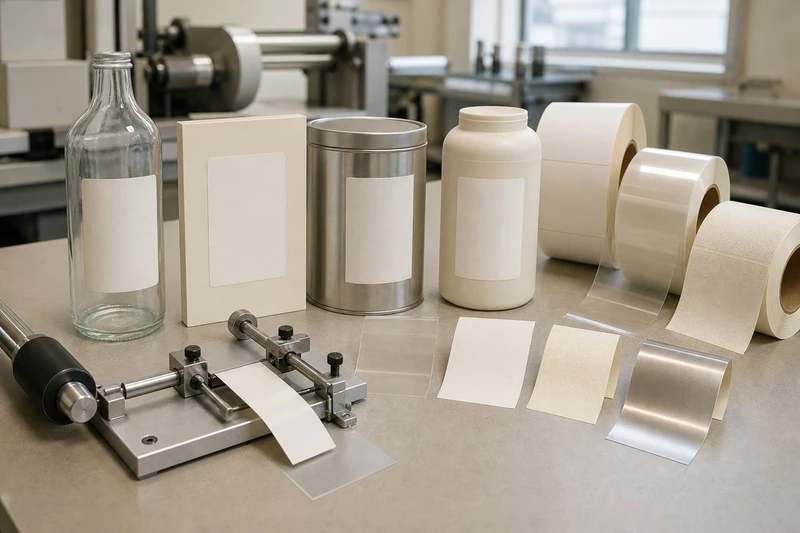
Choosing a label adhesive starts with the application surface, not the label artwork. An adhesive that performs well on a clean, smooth glass jar can lift from recycled cardboard, wrinkle around a tapered bottle or leave residue on a reusable container.
For reliable label adhesive selection, identify the substrate and its finish, assess the pack geometry, define the conditions it will face, decide how removable the label must be, and test the final label construction under realistic conditions. The adhesive, face stock, liner, ink and application method work together; selecting only the adhesive is rarely enough.
Identify the substrate and surface finish
The substrate is the material receiving the label. Its chemical composition and surface finish determine whether an adhesive can wet out properly and develop a dependable bond.
A useful starting point is surface energy. High-surface-energy materials allow adhesive to spread and form close contact more easily. Low-surface-energy materials resist that contact, so they commonly need a purpose-designed adhesive.
Start with the base material
Common packaging substrates create very different bonding conditions:
| Application surface | Typical adhesive challenge | Adhesive selection considerations |
|---|---|---|
| Glass | Usually smooth and high surface energy | Standard permanent adhesives often work well, but condensation, oil and curved shapes still matter. |
| Aluminium and steel | Smooth, but may carry oils or coatings | Check for manufacturing lubricants, powder coating, lacquer or condensation. |
| Paper and cardboard | Porous, fibrous and variable | Adhesive can soak into the surface or bond to loose fibres rather than the board itself. |
| Corrugated board | Uneven, dusty and textured | A more aggressive adhesive and flexible face stock may be needed for full contact. |
| PET and other plastics | Can range from moderate to low surface energy | Confirm the exact polymer and whether it has coatings, mould-release agents or anti-static treatment. |
| Polypropylene (PP) and polyethylene (PE) | Low surface energy | Usually needs an adhesive formulated for difficult plastics. Test carefully, especially with flexible packs. |
| Powder-coated or painted surfaces | Coatings vary widely | Adhesion depends on the coating chemistry, texture and curing quality, not just the material beneath it. |
| Timber, kraft paper and uncoated stocks | Porous and often dusty | Surface variation can be substantial; test on actual production material. |
Do not assume that two packs made from “plastic” will behave alike. For example, a clear PET tub, a polypropylene bottle and a polyethylene refill pouch have distinctly different surface properties. Material blends, recycled content, pigments, coatings and additives can also alter adhesion.
Check the surface finish, not just the substrate name
The same base material can have a gloss, matt, textured, embossed, coated, varnished, oily or dusty finish. Each can change the result.
Ask these questions before choosing an adhesive:
- Is the surface clean, dry and free from powder, oil, silicone or release agents?
- Is it glossy, matt, rough, porous or embossed?
- Does it have a water-based, UV, wax, varnish or laminate coating?
- Is the material recycled, and does its surface vary between batches?
- Will the pack be squeezed, flexed or handled frequently?
- Is the label applied to a seam, mould line, raised panel or recessed area?
A rough surface is not automatically difficult, but the adhesive needs enough flow and thickness to contact the high and low points. Conversely, some highly polished surfaces may appear ideal but can be coated with materials that reduce adhesion.
Treat recycled and natural materials as variable
Recycled cartonboard, uncoated kraft, timber and moulded fibre packaging can vary more than highly controlled films. Fibre lift, dust, absorbency and uneven texture may affect both initial tack and long-term adhesion.
When specifying labels for these materials, obtain samples from the actual packaging production run where possible. A label that sticks to a clean development sample may behave differently on a production carton that has been stored, printed, handled and die-cut.
Review flat, curved and tapered geometry
A label must conform to the shape of the pack as well as bond to its surface. Flat panels are generally the easiest application, while curved, tapered and flexible packs place extra stress on the label and adhesive.
Flat surfaces offer the widest adhesive choice
On a flat, rigid and clean panel, most compatible adhesives can establish even contact. However, corners, edges and folds are still vulnerable. A label placed too close to an edge can catch during handling and begin lifting, even where the central area remains firmly bonded.
For cartons and mailer boxes, consider the label’s placement relative to:
- Opening flaps and tear strips
- Fold lines and score marks
- Corrugated board ridges
- High-contact corners
- Areas touched during filling, packing or retail handling
A label should sit on a stable, reasonably smooth panel where its edges are unlikely to be repeatedly rubbed.
Curved containers need a conformable construction
Cylindrical jars, bottles, tins and tubes require the label to wrap around a radius. The tighter the curve, the more important it is to use a flexible face stock and a compatible adhesive with good initial tack.
For small-diameter containers, a stiff paper label may resist the curve and lift at the leading or trailing edge. A thinner or more flexible film face stock can reduce this “flagging” risk. The adhesive must also be able to maintain contact as the pack expands, contracts or is squeezed.
Measure the container diameter and confirm the intended label width. A wide label around a narrow bottle often has more difficulty conforming than a narrow label using the same adhesive.
Tapered packs are a separate problem
Tapered bottles, tubs, cups and jars are not simple cylinders. A rectangular label naturally wants to wrinkle or lift because the top and bottom circumferences differ.
Options include:
- Using a label shape designed for the taper, such as a curved or tapered profile
- Reducing label width so it covers less of the changing diameter
- Choosing a more conformable face stock
- Using a pressure-sensitive construction suited to the package geometry
- Reviewing whether a wraparound label is practical for the available application equipment
An adhesive cannot fully correct a label shape that is incompatible with the container. Geometry should be resolved before moving to a more aggressive adhesive.
Allow for flexible packaging
Pouches, sachets, refill packs and squeezable containers can flex substantially during filling, transport and use. A rigid label face stock may crease or pull away as the package bends. In these applications, the face material’s flexibility can be as important as adhesive strength.
Test labels on filled packs, not empty ones only. The behaviour of a pouch changes once it contains liquid, powder or other product.
Define temperature, moisture and handling exposure
Labels are often applied in one environment and used in another. Record both the application conditions and the full life cycle of the product. The best adhesive for a dry, room-temperature warehouse may be unsuitable for a chilled beverage, a bathroom product or an outdoor container.
Separate application temperature from service temperature
Application temperature is the pack and label temperature when the label is applied. Service temperature is the range encountered after application, including storage, transport and use.
Many adhesives need enough warmth at application to flow into the surface texture and build a bond. Applying a label to a cold container can reduce initial adhesion, even if that same adhesive performs adequately once bonded.
Define:
- Minimum and typical temperature during labelling
- Temperature in warehousing and transport
- Refrigerated, frozen or hot-fill exposure
- Temperature changes during consumer use
- Whether packs are labelled before or after chilling
A label applied to a cold bottle may need a cold-temperature adhesive specifically designed for the task. Do not rely on an adhesive simply because the finished product will later be stored cold.
Account for moisture, condensation and humidity
Water can interfere with adhesion in several ways. Condensation on a chilled bottle creates a physical barrier between adhesive and pack. High humidity can affect paper-based labels and porous packaging. Repeated exposure to water can challenge edge adhesion and cause some paper labels to distort.
Consider the actual exposure:
- Will labels be applied to dry packs, or may there be condensation?
- Will products be kept in a fridge, ice bucket or cool room?
- Is the product likely to be used in a bathroom, kitchen or outdoor setting?
- Will the label contact splashes, oils, cleaning products or food residues?
- Does the package go through pasteurisation, retort processing or another demanding process?
For wet-use products, the adhesive is only one part of the solution. A moisture-resistant face stock, suitable print system and protective finish may all be necessary to preserve legibility and appearance.
Include handling and friction in the brief
Repeated handling can wear at label edges. This is especially relevant for retail jars, tool containers, refill packs, shipping cartons and products carried in bags or stored in cupboards.
High-friction contact points include:
- Leading and trailing edges on wraparound labels
- Corners of boxes
- Squeeze zones on bottles and tubes
- Packs stacked closely in transit
- Areas gripped during opening
- Surfaces exposed to scuffing on conveyors
If the label is part of a product presentation rather than a temporary logistics mark, specify expected handling conditions early. A stronger adhesive alone may not prevent scuffing, tearing or face-stock damage.
Choose permanent, removable or repositionable behaviour
The required end-of-life behaviour is a core part of label adhesive selection. “Strong” is not always better. The right option is the one that meets the product’s purpose without damaging the surface or leaving unacceptable residue.
| Adhesive behaviour | Best suited to | Main benefit | Key risk to manage |
|---|---|---|---|
| Permanent | Product identification, branded packaging, safety information and long-term retail labels | Designed to remain attached for the intended product life | May tear paper, damage delicate finishes or leave adhesive during removal. |
| Removable | Promotional labels, temporary pricing, reusable containers and short-term identification | Can be removed more cleanly within its intended conditions and timeframe | Performance can change with ageing, heat, surface type and storage time. |
| Repositionable | Labels needing placement adjustment during application | Allows initial lift-and-reapply before final bonding | It may not provide the long-term holding strength needed for demanding surfaces. |
Specify what “permanent” must mean
A permanent adhesive does not mean it can never be removed. It means the label is intended to stay attached under the defined use conditions. On some surfaces, removal may leave residue; on others, the label may tear before the adhesive releases.
For a permanent product label, define:
- Required bond life
- Expected storage and use conditions
- Whether edge lift is acceptable at any point
- Whether the label will cover instructions, batch data or branding that must remain readable
- Whether consumers may try to remove it
When a label must remain on a pack through moisture, refrigeration or handling, test those exact conditions rather than relying on the word “permanent”.
Define removable performance precisely
A removable adhesive should be specified by the removal outcome needed, not by a general request for “easy peel”.
Clarify:
- The surface from which it must remove
- The expected removal window: days, weeks or months
- Storage temperatures before removal
- Whether removal must be clean by hand
- Whether slight adhesive transfer is acceptable
- Whether the label is removed from glass, plastic, coated board or another material
A removable label may peel cleanly from smooth glass but leave adhesive on a rough powder-coated surface. It may also become more difficult to remove after prolonged heat exposure or ageing. Therefore, removal requirements must be tested at the intended end point, not only shortly after application.
Use repositionable adhesives for placement, not as a workaround
Repositionable adhesives are useful when labels need to be aligned manually or where pack variation makes first-pass placement difficult. They can reduce waste from crooked labels during hand application.
However, repositionability is not a substitute for selecting a compatible adhesive. If the package is cold, oily, low-energy or highly textured, a repositionable option may not build enough final adhesion. Confirm the required dwell time before assessing the final bond.
Test ageing, edges and residue before approval
A label that looks acceptable immediately after application may fail after a few days, temperature cycling or ordinary handling. Testing should assess the pack-label combination over time.
Test the actual production combination
Use final or representative versions of:
- The packaging substrate and its coating
- The label face stock and adhesive
- Printed inks, varnish or laminate
- Label size, shape and corner profile
- Application method and pressure
- Product fill state, where relevant
Testing a plain unprinted label on a different sample container may be useful as an early screen, but it is not sufficient for final approval.
Allow time for bond development
Pressure-sensitive adhesives often develop stronger adhesion after application. Check samples immediately, then again after a suitable dwell period. The right interval depends on the adhesive system and application, so confirm the test plan with the supplier or converter.
Inspect for:
- Leading-edge and trailing-edge lift
- Corner flagging
- Tunnelling, bubbles or wrinkles
- Adhesive ooze at edges
- Label shrinkage or expansion
- Face stock lifting from the adhesive
- Print or varnish cracking
- Pack distortion beneath the label
Include realistic ageing conditions
A practical label trial can include storage at normal conditions plus the stress conditions relevant to the product. Examples may include refrigeration, warm storage, humidity, repeated handling, water exposure or temperature changes.
Avoid overstating test results. A label passing a short bench test does not automatically prove performance across every batch, season or supply change. Instead, use testing to identify the most likely failure modes and set an approval standard that reflects the actual application.
Assess residue and surface damage after removal
For removable or temporary labels, inspect the substrate after removal at the expected end of the label’s life. Look for:
- Adhesive residue
- Paper fibre tear
- Lifted ink, varnish or coating
- Changes in gloss or surface appearance
- Staining or adhesive shadowing
- Damage to delicate finishes
Removal angle, speed and temperature can affect results. Test how a normal user is likely to remove the label, rather than using an unusually slow or careful technique that will not reflect real-world handling.
Approve the complete label construction
The adhesive is one layer in a complete label construction. A successful specification considers the face stock, adhesive, release liner, print finish, die-cut shape and application process together.
Match face stock to the pack and environment
Paper labels can provide a natural, tactile look and suit many dry applications. Film labels are often more flexible and better suited to moisture-prone or squeezeable packaging. Neither is universally better.
The face stock should be assessed for:
- Flexibility around curves and tapers
- Resistance to moisture and scuffing
- Appearance on clear, dark or textured packs
- Compatibility with printing, varnish and embellishments
- Resistance to tearing during use or removal
- Suitability for hand or machine application
For instance, choosing an aggressive adhesive for a small curved bottle may still produce edge lift if the paper face stock is too rigid. The construction must be evaluated as a system.
Check label shape, size and corner design
Sharp corners are more likely to catch and lift than rounded ones. Very large labels can struggle on flexible packs, while a label that crosses a seam or highly textured area may not achieve consistent contact.
Before approving artwork and die lines, confirm:
- Label dimensions and placement tolerances
- Whether the design crosses curves, seams, ribs or recesses
- Corner radius
- Gap between labels on a roll, if machine applied
- Required barcode scan area and print legibility
- Whether the label needs to cover variable data
Good adhesive selection cannot compensate for a label that is oversized, poorly positioned or shaped against the pack geometry.
Consider the application process
Hand application and automated application place labels differently. Machine settings, dispensing speed, wipe-down pressure and label alignment can all influence adhesion. If labels are applied by hand, operators need a practical way to apply even pressure, especially around curved surfaces.
Share the following details with the label supplier or packaging team:
- Pack material, finish and photographs of the application area.
- Pack dimensions, including taper or diameter.
- Label size, shape and intended position.
- Application temperature and method.
- Storage, transport and end-use conditions.
- Requirement for permanent, removable or repositionable behaviour.
- Any exposure to water, oils, chemicals, refrigeration or heat.
- The test conditions and pass/fail criteria.
For labels paired with cartons, bottles or promotional packaging, reviewing the available custom sticker options alongside the full packaging specification can help narrow down suitable constructions.
Common label adhesive selection mistakes
Several issues recur during packaging development:
- Selecting by substrate name alone: “Plastic” and “cardboard” are too broad; finish, coatings and additives matter.
- Ignoring application temperature: A suitable room-temperature adhesive may fail when applied to cold packs.
- Using a stronger adhesive to solve a geometry problem: Curves, tapers and flexing often require changes to label material, shape or size.
- Testing only at application: Edge lift and residue commonly appear after dwell time or environmental exposure.
- Approving labels on empty packs: Filled packs may flex, sweat or change shape.
- Assuming removable means residue-free everywhere: Clean removal always depends on the surface, time and conditions.
- Changing a pack coating without retesting: A new varnish, recycled content level or supplier can affect adhesion.
- Treating print finish as separate from performance: Lamination, varnish and ink coverage may alter flexibility and durability.
FAQ
Which adhesive works best on low-surface-energy plastic?
Polyethylene and polypropylene typically require an adhesive formulated for low-surface-energy surfaces. The exact choice depends on the plastic grade, mould-release residues, pack flexibility, temperature and moisture exposure. Always test on the finished production pack.
Can a label adhesive stick to a refrigerated bottle?
Yes, but the key question is whether the bottle is cold when labelled and whether condensation is present. A label applied dry at room temperature before refrigeration has different requirements from one applied directly to a chilled, damp bottle. Specify both application and storage conditions.
Why do labels lift at the corners?
Corner lift can result from a rigid face stock on a curve, poor surface cleaning, insufficient application pressure, cold application, label placement near a high-contact area, sharp corners or an adhesive that does not suit the surface. Inspect the failure pattern before changing materials.
Is a removable label always easy to remove?
No. Removability varies with the substrate, storage period, heat, humidity and adhesive dwell time. A removable label should be approved against a defined removal window and surface, with residue checks after realistic ageing.
Should I choose the adhesive before designing the label?
The initial adhesive direction should be chosen early, but final approval should happen after the label size, shape, face stock, finish and application process are known. These factors can materially affect performance.
A practical next step is to create a one-page application brief covering the pack surface, geometry, temperatures, exposure conditions and removal requirement. Use it to compare sample label constructions on the actual pack before committing to full production.
