
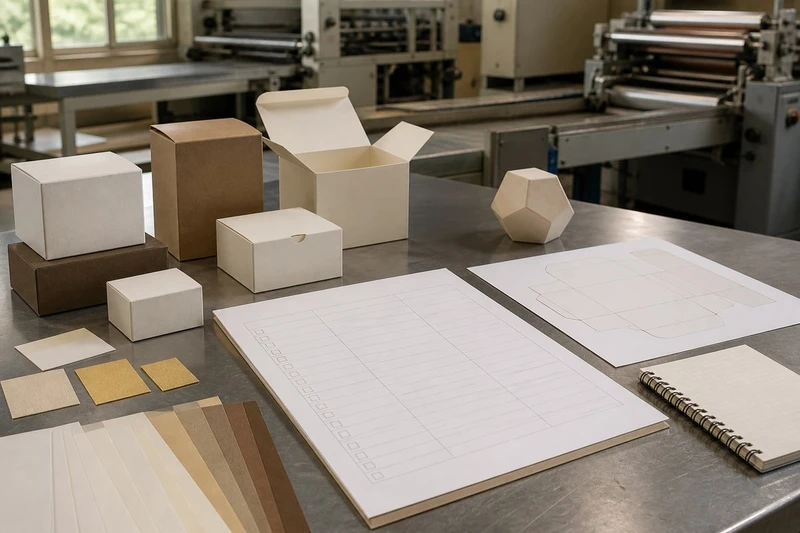
A useful packaging quote starts with a clear brief. Before approaching a supplier, document what the product is, how it will be sold, the box dimensions and strength needs, the artwork requirements, expected order volumes, and how the finished packaging must arrive.
This custom packaging brief checklist helps Australian brands and buying teams reduce back-and-forth, compare proposals fairly and identify issues before they affect cost, lead time or pack-out. You do not need every final answer at the first enquiry, but clearly label any assumptions or items still being decided.
Define the product and sales channel
Start with the product the packaging must protect, present and support. A supplier cannot recommend a suitable box style, board grade or packing method from a product name alone.
Include a short product summary covering:
- Product name, SKU or range name
- Product category and intended use
- Whether it is a single item, multi-pack, set, subscription box or gift bundle
- Product value and presentation expectations
- Whether the item needs tamper evidence, shelf-ready display or mailing protection
- Any packaging already in use and the reason for changing it
The sales channel matters because packaging faces different handling conditions in a boutique, retail chain, warehouse or e-commerce fulfilment operation.
Match the packaging to the way it is sold
Use your brief to state where the package will be used and what it needs to achieve.
| Sales channel | Information to include in the brief | Common packaging priority |
|---|---|---|
| Retail shelf | Shelf orientation, display quantity, barcode placement, retailer requirements and whether products are stacked | Visual impact, consistent dimensions and shelf presentation |
| E-commerce | Whether the box is mailed directly, outer satchel/carton use, likely handling and unboxing expectations | Product protection, efficient packing and low void space |
| Gift and premium retail | Gift occasion, wrapping expectations, insert requirements and desired opening experience | Finish quality, rigid construction and presentation |
| Wholesale | Master carton quantity, warehouse handling and whether labels are applied during packing | Efficient storage, repeatability and clear identification |
| Events or promotions | Campaign dates, assortment details and whether packs are handed out or transported in bulk | Fast assembly, portability and brand visibility |
For instance, a candle sold through a shop may need a visually refined folding carton, while the same candle sold online may also require an insert or protective mailing solution. One box does not always perform both jobs well.
If your product is intended as a present, describe the unboxing sequence as well as the pack format. A supplier can then assess whether a folding carton, magnetic closure box, drawer box or other custom gift packaging format is appropriate.
Identify non-negotiable constraints
List any requirements that cannot be changed. These may include:
- A maximum outer size due to retail shelving or shipping rules
- A required barcode, warning panel or ingredient list
- A product launch date or replenishment window
- Existing brand colours that must be matched
- A fixed insert, bottle shape or accessory layout
- A retailer-provided packaging specification
- A target unit cost range, if you have one
It is better to state a cost target as a planning guide than to leave suppliers guessing. However, do not treat an early quote as final if dimensions, materials, printing coverage or quantity are not yet settled.
Record dimensions, weight and fragile points
Accurate product data is the foundation of a practical packaging recommendation. “Small”, “standard size” and product photos are not enough for structural design or reliable quoting.
Measure the finished product, including anything that changes its real footprint: caps, handles, cables, lids, protective sleeves, bundled accessories and labels.
Record:
- Length × width × height in millimetres
- Product weight in grams or kilograms
- Shape: square, cylindrical, tapered, irregular or flexible
- Whether the product has sharp corners, moving parts or protrusions
- Whether it can be stacked, laid on its side or must remain upright
- Whether it is sensitive to crushing, vibration, moisture, scratching or temperature changes
- Whether more than one item goes into each retail pack
Specify whether dimensions are for the product itself or for an existing packaged item. For new packaging, suppliers generally need the bare product dimensions plus any necessary clearance.
Add clearances and critical protection points
A box that exactly matches a product’s measurements may be too tight to assemble or may damage the item during packing. Conversely, too much empty space can allow movement and increase the risk of scuffing or breakage.
Mark the product’s vulnerable areas in words or photographs. Examples include:
- A glass bottle neck
- A jar lid that can loosen
- A screen or polished surface that scratches easily
- A ceramic handle
- A pointed cosmetic applicator
- A delicate internal component
- A product face that must look pristine on arrival
Include photos from multiple angles, ideally with a ruler or a known scale. If the product is not final, provide a prototype, technical drawing or dimensional tolerance range. State what may change before production.
Separate internal and external dimensions
Your brief should distinguish between:
- Internal dimensions: the usable space inside the pack.
- External dimensions: the finished size outside the pack, affected by material thickness, folds, inserts and closures.
- Product dimensions: the measurements of the item being packed.
This distinction is especially important for nested boxes, drawer boxes, rigid boxes, fitted inserts and packaging that must fit into a postal carton or retail display.
A common mistake is to request a box “200 × 150 × 50 mm” without saying whether those are internal or external dimensions. If you are unsure, say so and provide the product measurements instead.
Set quantity and repeat-order expectations
Quantity affects material use, setup requirements, production planning and unit cost. Give suppliers an estimate that reflects how you expect to buy, not only the first order you hope to place.
State:
- Initial order quantity
- Estimated annual volume, if known
- Likely repeat-order quantity
- Number of SKUs, sizes, colours or artwork versions
- Whether each version will be ordered in equal quantities
- Whether the packaging is seasonal, ongoing or campaign-specific
- Whether quantities are firm, indicative or subject to approval
For example, 5,000 units of one design is commercially different from 5,000 units split across five designs. Even where the box structure is identical, separate artwork versions may have different setup and production implications.
Explain how variable demand will be managed
If your forecast is uncertain, ask for options at several order volumes rather than relying on one price. A useful request may compare 1,000, 3,000 and 5,000 units, provided the specification remains the same.
Also confirm whether you need:
- Stock held for staged releases
- Multiple deliveries to different locations
- Separate labelling by SKU
- Short-run campaign packaging alongside a core line
- A repeatable specification for future reorders
Avoid requesting a quote based only on an approximate quantity such as “a few thousand”. A range is better than no guidance, but a supplier will be able to provide more useful options when you nominate probable quantities.
Describe brand artwork and finish needs
Your packaging brief should show both the visual direction and the practical print requirements. A mood board can communicate the intended feel, but it does not replace production-ready artwork.
Provide whatever is available, such as:
- Brand guidelines
- Logo files in suitable editable formats
- Packaging dielines, if already developed
- Print-ready artwork, if complete
- Pantone or other spot-colour references where applicable
- CMYK values, where used in your brand system
- Product photography, illustrations and mandatory copy
- Examples of packaging you like or dislike, with an explanation why
If the artwork is not ready, state this plainly. You can still request an indicative structural quote, but note that final print pricing may change with coverage, colours, finishes and artwork complexity.
Specify the visual hierarchy
Describe what customers should notice first. This helps determine panel layout, print treatment and opening experience.
A practical design note might cover:
- The front-facing product name or logo.
- Required product information, instructions or warnings.
- Barcode placement and quiet-space needs.
- Social, recycling or contact information.
- Any retail-facing panel that must remain visible on shelf.
- The areas where a premium finish is most valuable.
If you need labels as part of the wider pack system, identify their dimensions, application surface, finish and expected quantity separately. This is particularly useful when ordering custom printed stickers and labels for jars, mailers, product seals or promotional packs.
Choose materials and finishes by purpose, not appearance alone
Use reference samples where possible, but explain the intended outcome rather than naming a finish without context. Terms can be interpreted differently between suppliers.
Common considerations include:
- Folding carton, corrugated board or rigid board construction
- Matte, gloss or soft-touch lamination
- Uncoated, textured or specialty paper stocks
- Foil stamping, embossing, debossing or spot UV
- Window cut-outs
- Printed interiors
- Single- or double-sided printing
- White ink requirements for darker or clear materials
- Insert material and colour
Every embellishment can affect cost, production steps and the risk of visual variation. Ask which finishes are compatible with your selected substrate and whether they are suitable for the package’s handling conditions.
Do not assume a digital screen colour will print exactly the same on every paper or board. Where brand colour is critical, ask about proofing options and define the acceptable approval process before full production.
Confirm packing, assembly and delivery requirements
A well-designed box can still create operational problems if it arrives in the wrong format or takes too long to assemble. Include your packing workflow in the brief.
Explain who will pack the products and where this happens: an internal team, a contract packer, warehouse staff, retail team or fulfilment partner. Then state the preferred delivery format.
Important details include:
- Flat-packed or pre-assembled packaging
- Assembly steps and whether adhesive, tape or tools are required
- Required assembly speed or labour constraints
- Whether inserts arrive attached, loose or nested
- Units per inner bundle, carton or pallet
- Whether cartons need SKU labels, carton marks or handling instructions
- Whether packs must be counted, bagged or separated by artwork version
- Storage conditions and available warehouse space
Consider freight and storage before approving the format
Pre-assembled rigid boxes may reduce assembly work, but they can occupy much more storage and transport volume than flat-packed cartons. Flat-packed packaging may be more efficient to store, but only if your team can assemble it consistently and without damaging the finish.
Ask your supplier to clarify:
- Finished carton dimensions and gross weight
- Units per shipping carton
- Whether pallets are used and how cartons are arranged
- Whether packaging can be packed to suit your receiving process
- Any storage or handling conditions that could affect the material or finish
- What information is needed for delivery booking or site access
For Australian businesses using third-party fulfilment or retail distribution, check their receiving requirements before confirming carton labels and pallet configuration. These requirements can vary substantially between operators.
Be realistic about timing
Include your desired in-hands date, but separate it from the date you expect to approve artwork, samples or final specifications. Production timing can only be planned reliably once key decisions are confirmed.
A clear timeline section should identify:
- Date the quote is needed
- Date artwork will be supplied or approved
- Whether a prototype, plain sample or print proof is required
- Final approval deadline
- Required delivery date
- Any campaign, launch or retailer milestone driving the date
If timing is flexible, say so. If it is fixed, explain which approvals are already complete and which are still pending.
Build the final supplier handover checklist
Use this checklist before requesting a quote for custom boxes, labels or gift packaging. Attach supporting files wherever possible and mark unknown details as “to be confirmed” rather than omitting them.
Product and packaging purpose
- [ ] Product name, SKU and product category
- [ ] Product photos or drawings
- [ ] Product dimensions and weight
- [ ] Product orientation and packing configuration
- [ ] Fragile points, sensitive surfaces and handling restrictions
- [ ] Required packaging function: retail, e-commerce, gifting, wholesale or promotion
- [ ] Preferred packaging style, if known
- [ ] Existing packaging sample or reference images, if relevant
Size and structure
- [ ] Internal dimensions, external dimensions or product measurements clearly labelled
- [ ] Number of items per pack
- [ ] Insert, divider, window or closure requirements
- [ ] Maximum external size limitations
- [ ] Required product clearance and movement control
- [ ] Stackability and transport considerations
Quantity and commercial information
- [ ] Initial order quantity
- [ ] Forecast repeat-order quantity or annual estimate
- [ ] Number of SKUs and artwork versions
- [ ] Expected order frequency
- [ ] Target budget range, if available
- [ ] Whether the project is an initial run, relaunch or ongoing range
Artwork and print requirements
- [ ] Brand guidelines and logo files
- [ ] Print-ready artwork or estimated artwork completion date
- [ ] Colour references and critical brand colours
- [ ] Required copy, barcode and legal or product information
- [ ] Desired board, paper, print treatment and finish
- [ ] Examples of preferred packaging styles
- [ ] Sample or proof expectations before production
Assembly, packing and delivery
- [ ] Flat-packed or assembled delivery preference
- [ ] Who assembles and fills the packaging
- [ ] Insert and accessory packing method
- [ ] Units per shipping carton or requested packing configuration
- [ ] Carton labels, SKU separation or pallet requirements
- [ ] Delivery address, receiving constraints and required date
- [ ] Contact responsible for artwork, structural approval and delivery coordination
Common brief mistakes that make quotes hard to compare
The most common issue is comparing prices for different specifications. One supplier may assume a basic folding carton while another includes an insert, premium finish or assembled delivery format.
Watch for these gaps:
- No product measurements: Suppliers must estimate, which can lead to unsuitable dimensions.
- Artwork-only enquiries: A design file does not explain board grade, box construction or delivery format.
- Unclear quantities: The unit price may change significantly at different volumes.
- Missing version counts: Multiple SKUs can affect setup and packing requirements.
- No finish definition: “Premium” is subjective; name the desired effect or show references.
- Assuming samples are identical to production: Confirm what type of sample or proof is being supplied and what it validates.
- Ignoring outer-carton needs: Retail packaging may look right but arrive damaged without suitable transit protection.
- Treating delivery as an afterthought: The receiving format may affect warehouse labour, freight volume and storage.
When comparing supplier proposals, align the basics first: box style, finished dimensions, material, print coverage, finishing, insert design, quantity, packing format, samples, delivery scope and exclusions. Ask questions about differences rather than selecting purely on the lowest unit price.
A practical next step
Create a one-page brief using the checklist above, then attach product photos, dimensions, artwork files and any reference packaging. If you are still selecting a pack format, review suitable custom box options before requesting like-for-like proposals.
For projects that need a supplier discussion, XGolden Print provides custom packaging boxes and printing solutions, with 27 years of experience in packaging production. A complete brief will help any supplier give clearer recommendations and make your eventual quote comparison more meaningful.
