
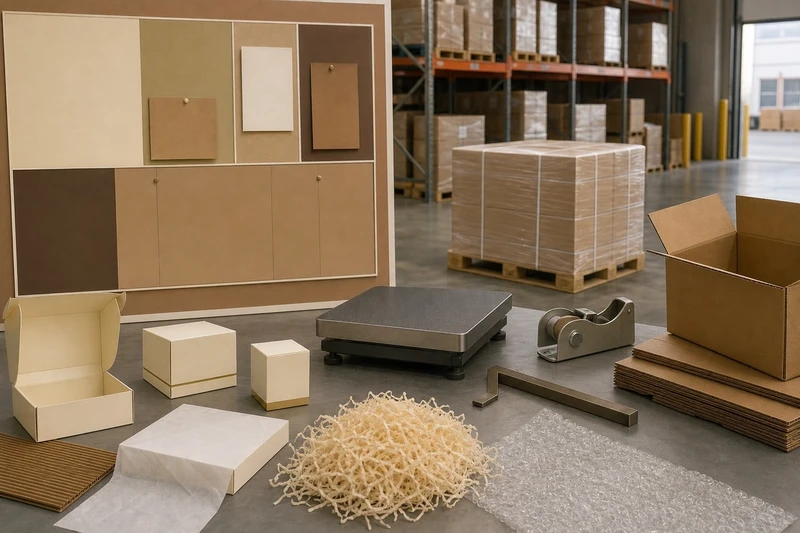
The total landed cost of custom packaging is the full cost to have usable packaging available for your operation—not simply the supplier’s quoted price per box. It includes specification-dependent production costs, one-off charges, transport, import-related charges, local delivery, storage, damage, handling and any assembly required before use.
To compare packaging quotations properly, put every option into the same calculation: total spend divided by the number of usable, ready-to-pack units. This prevents a low unit price from appearing cheaper when it carries higher freight, inefficient packing, greater damage risk or unplanned local costs.
Start with the complete product specification
A landed-cost calculation is only useful when every supplier is pricing the same packaging specification. If one quote is for a lighter board, different finish, lower print coverage or an unassembled carton while another is for a finished retail-ready box, their unit prices are not directly comparable.
Create a single written specification before requesting or reviewing quotes. Include the details that affect both production cost and freight efficiency.
Packaging details to define
For a custom box or printed packaging project, record:
- Box style and finished dimensions: Length, width and height, plus whether measurements are internal or external.
- Material: Board grade, flute type for corrugated packaging, paper weight, rigid-board thickness or other agreed material details.
- Print: Number of colours, print coverage, inside printing, special inks and artwork versions.
- Finish: Matte or gloss lamination, varnish, foil, embossing, debossing, spot effects, window patches or other treatments.
- Construction: Folded, glued, flat-packed, pre-assembled, magnetic closure, inserts, dividers, handles or ribbon.
- Accessories: Labels, sleeves, tissue, cards, seals or product inserts that must be included in the delivered pack.
- Quantity: Total order quantity and, where relevant, the quantity per design, SKU or size.
- Packing method: Units per inner pack, cartons per pallet, carton dimensions and gross weight.
- Delivery point: Your warehouse, co-packer, fulfilment provider or retailer’s distribution centre.
- Acceptance requirements: Colour expectations, dimensional tolerances, barcode placement, packing requirements and any product-specific requirements.
Ask each supplier to identify any assumptions made in their quote. For example, a quote may assume one artwork version, a standard exterior print finish, flat packing or delivery to a particular port rather than to your warehouse.
For projects involving folding cartons, mailer boxes or presentation packaging, reviewing available custom box options can help turn a general concept into a comparable specification.
Calculate the usable quantity, not just the ordered quantity
The denominator in your calculation should be the number of units you can actually use. That may be less than the quantity ordered due to sample retention, transit damage, handling loss, production allowance or quality rejects under the agreed commercial terms.
Use this basic relationship:
Usable units = Delivered units − unusable or reserved units
Then calculate:
Total landed cost per usable unit = Total project cost ÷ Usable units
A packaging buyer ordering 20,000 boxes should not automatically divide costs by 20,000 if some cartons are damaged in transit, retained for inspection or cannot be used because they do not fit the product.
Separate tooling, sampling and unit costs
Custom packaging has both one-off and recurring costs. Combining them into one unit price can make quotations difficult to compare, particularly where a design may be reordered later.
Separate the quotation into the following categories.
| Cost category | What it may include | How to assess it |
|---|---|---|
| One-off tooling | Dies, plates, moulds, cutting tools or setup | Confirm whether it applies once, per design, per size or per reorder |
| Sampling | Plain samples, printed samples, prototypes, courier charges and revisions | Check what is included and whether sampling is credited against production |
| Production unit cost | Materials, printing, finishing, converting and standard packing | Compare only against an equivalent specification and quantity |
| Artwork-related work | File checks, layout changes, barcode adjustments or prepress | Confirm whether this is included, optional or charged by revision |
| Packing cost | Inner packs, export cartons, pallets or protective material | Determine whether this is built into the unit price or listed separately |
Spread one-off costs across the expected order life
For a first order, include all applicable one-off costs in the landed-cost calculation. For a multi-order programme, allocate those costs across the quantity you reasonably expect to buy before the design changes.
For example:
Amortised tooling cost per unit = Total tooling cost ÷ Expected lifetime quantity
If tooling costs $1,200 and you expect to purchase 60,000 units over the life of the packaging design, the allocated tooling cost is $0.02 per unit. If the design is likely to change after the first 10,000-unit run, allocating the same tooling across 60,000 units would understate the true first-cycle cost.
Keep two views where useful:
- First-order landed cost: Includes all tooling, sampling and launch costs.
- Repeat-order landed cost: Includes recurring production, freight and local handling costs, but excludes costs that genuinely will not recur.
This distinction is especially important when comparing a short promotional run with an ongoing retail packaging programme.
Check whether samples represent final production
A sample can be valuable without being a complete prediction of the final run. Ask what the sample is intended to validate:
- Structural fit and product protection
- Material appearance and finish
- Print placement and artwork content
- Colour appearance under the agreed process
- Assembly method
- Carton packing configuration
If colour is critical, agree how it will be approved and what reference will be used before production. Avoid assuming that a digital mock-up, unprinted prototype or screen image is equivalent to production output.
Include packing, freight, duties and local charges
Freight and import-related costs can materially change the total landed cost custom packaging buyers pay in Australia. They should be treated as separate line items unless the seller’s delivery terms clearly state they are included.
The correct transport and import charges depend on shipment value, product classification, origin, transport mode, delivery terms and the way the goods enter Australia. Rather than inserting generic rates, obtain current estimates from the supplier, freight forwarder, customs broker or logistics team for the specific shipment.
Build the logistics side of the calculation
A practical formula is:
Total delivered cost = Production costs + Export packing + International freight + Cargo cover if used + Import-related charges + Australian transport + Handling costs
Your worksheet should allow for the following.
Export packing and shipment preparation
Confirm whether the production quote includes:
- Outer export cartons
- Pallets, if required
- Corner protection, stretch wrap or other pallet protection
- Carton markings and labels
- Export documentation
- Loading or collection charges
- Any supplier-to-port or supplier-to-terminal transport
Packaging that has a low unit price but poor carton utilisation can cost more to ship. Ask for carton dimensions, cartons per pallet, gross weight and total shipment volume before selecting a transport option.
International freight
Obtain a current freight estimate based on the actual shipment profile. Freight can be charged by weight, volume, container use or a combination of shipment characteristics and service charges.
For fair comparison, request that freight estimates state:
- Mode of transport
- Port or airport of arrival
- Estimated charge basis
- Validity period
- Whether terminal, documentation or fuel-related charges are included
- Any minimum charge
- Whether the estimate assumes loose cartons, pallets or container loading
Do not compare an ocean-freight estimate for one supplier with an air-freight estimate for another unless speed is deliberately part of the decision. If lead time matters, model each option separately rather than mixing transport modes into one comparison.
Duties, GST and clearance-related charges
Imported packaging may attract customs duty, GST and charges associated with customs clearance, inspections or port handling, depending on the goods and transaction. The applicable treatment can vary with tariff classification, country of origin, declared value, Incoterms® rule, shipment method and other circumstances.
For this reason, your cost sheet should have separate fields for:
- Estimated customs duty
- GST or applicable tax treatment
- Customs broker or clearance fee
- Port, terminal or depot charges
- Inspection, treatment or storage charges if they arise
- Any documentation or processing fees
Confirm the current position with a qualified customs broker, freight forwarder or relevant government source before approving a purchase order. Do not rely on an old freight quote or a duty assumption from a different product category.
Australian delivery and receiving costs
The shipment is not truly landed until it reaches the place where your team can use it. Include:
- Delivery from port, airport, depot or warehouse to your nominated site
- Booking fees for warehouses or distribution centres
- Unloading or tail-lift requirements
- Pallet exchange or pallet disposal where relevant
- Receiving, count checks and put-away labour
- Transfers from your warehouse to a co-packer or fulfilment provider
Clarify the agreed delivery term in writing. A quote described as “delivered” may still exclude some destination charges, local transport, unloading or taxes.
Model storage, damage and assembly costs
The cheapest delivered box is not always the cheapest usable box. Packaging can create downstream costs after it arrives, particularly for bulky cartons, rigid gift boxes, fragile finishes or complex constructions.
Storage cost
Storage is often overlooked because packaging may arrive weeks or months before a product launch. Calculate how much warehouse space it occupies and how long it will be held.
Consider:
- Number of pallets or cubic metres
- Average storage duration
- Warehouse rent or third-party storage fees
- Inbound handling and put-away
- Stock counting and inventory administration
- Internal moves or replenishment labour
- Cash tied up in packaging inventory
Flat-packed cartons may reduce storage volume, but they may need labour or equipment to erect. Pre-assembled packaging can simplify packing operations but occupies more space. Compare these trade-offs against your actual warehouse and packing process.
Damage, spoilage and obsolescence allowance
Include a realistic allowance for packaging that cannot be used. Causes may include transit crushing, moisture exposure, scuffing, mishandling, outdated artwork, a product-size change or a campaign that ends before stock is consumed.
Use an assumption that your team can explain and update:
Expected loss cost = Packaging value × Expected unusable proportion
For example, if a packaging format is particularly vulnerable to scuffing or if the design is seasonal, model a higher contingency than for a plain, long-running shipping carton. The aim is not to predict every loss precisely; it is to avoid treating the risk as zero.
Assembly and packing-line labour
Ask whether the packaging arrives flat, partly assembled or ready to fill. Then calculate the labour and equipment implications at your site or through your co-packer.
Potential costs include:
- Box erection and taping
- Applying labels, seals or sleeves
- Folding inserts or dividers
- Adding tissue, cards or ribbons
- Quality checks during assembly
- Training and line changeover
- Rework when components do not fit together
A useful measure is:
Assembly cost per unit = Total assembly labour and overhead ÷ Units assembled
Where possible, conduct a small packing trial with the actual product, packaging components and packing team. A few seconds added to every order can outweigh a small saving in packaging purchase price.
Compare scenarios on the same basis
The most reliable comparison is a scenario model where each option has the same order quantity, product specification, delivery point, forecast demand period and usable-unit calculation.
Example landed-cost comparison framework
Use your own supplier figures and current logistics estimates in a table like this:
| Cost item | Option A: lower unit price | Option B: higher unit price |
|---|---|---|
| Production cost | Enter amount | Enter amount |
| Tooling and samples | Enter amount | Enter amount |
| Export packing and origin costs | Enter amount | Enter amount |
| International freight | Enter amount | Enter amount |
| Import and clearance-related charges | Enter amount | Enter amount |
| Australian delivery | Enter amount | Enter amount |
| Storage and handling | Enter amount | Enter amount |
| Assembly labour | Enter amount | Enter amount |
| Damage or obsolescence allowance | Enter amount | Enter amount |
| Total project cost | Enter total | Enter total |
| Usable units | Enter quantity | Enter quantity |
| Landed cost per usable unit | Calculate | Calculate |
Do not stop at cost per unit if the options serve different business needs. Add decision criteria that affect the commercial outcome:
- Can the supplier meet the agreed product specification?
- Does the packaging protect the product through your actual distribution channel?
- Is the required ordering quantity compatible with demand?
- Does the packaging fit your storage and fulfilment process?
- Are repeat-order costs and lead-time assumptions acceptable?
- How exposed is the option to artwork changes, seasonal demand or product revisions?
- Are the quote terms clear enough to budget reliably?
Use sensitivity testing for uncertain costs
Some inputs will be estimates, particularly freight, import charges, storage duration and wastage. Test how the decision changes if those assumptions move.
For each option, create at least three cases:
- Expected case: Your most reasonable current assumptions.
- Higher-cost case: Higher freight, longer storage, additional handling or greater damage.
- Lower-cost case: More favourable logistics and faster stock turnover.
If one option remains lower cost across all realistic cases, it is more robust. If the result changes with a modest freight increase or small rise in wastage, focus on reducing that uncertainty before committing.
Record assumptions and quote exclusions
A quote is not a complete cost model unless its assumptions and exclusions are documented. Record them in the purchase file so that procurement, finance, operations and product teams are working from the same basis.
Assumptions to document
At minimum, write down:
- Currency used and exchange-rate assumption, if applicable
- Order quantity and SKU split
- Product and packaging specification version
- Artwork version and number of designs
- Tooling, sampling and setup charges
- Incoterms® rule and named place
- Freight mode, route and quote validity
- Customs classification and import-cost assumptions
- Delivery point and unloading responsibility
- Carton, pallet and shipping-volume details
- Storage period and warehouse cost assumption
- Damage, spoilage and obsolescence allowance
- Assembly method, labour rate and expected productivity
- Expected usable quantity
- Payment timing and any financing cost assumptions
Common quote exclusions to check
Before comparing suppliers, ask whether the quote excludes any of the following:
- Freight or destination charges
- Duties, GST, broker fees or customs clearance costs
- Artwork changes, prepress corrections or extra revisions
- Tooling, plates, dies or setup
- Samples and sample freight
- Special finishes, components or hand assembly
- Pallets, protective packing or carton labels
- Local delivery, unloading or warehouse booking fees
- Storage after an agreed collection date
- Inspection, treatment or charges caused by a shipment delay
- Rework, replacement or disposal of unusable stock
An exclusion is not necessarily a problem. It simply needs to be visible in the comparison. A transparent quote with clearly separated costs is generally easier to evaluate than an all-in figure with undefined scope.
A practical landed-cost checklist before approval
Before approving custom packaging, confirm that you can answer “yes” to these questions:
- Is every supplier pricing the same written specification?
- Have one-off tooling and sample costs been separated from recurring unit costs?
- Do you know the shipping carton size, total volume and gross shipment weight?
- Are transport, import-related and Australian delivery charges included or explicitly estimated?
- Have you calculated cost per usable unit rather than ordered unit?
- Have storage, handling, assembly and likely loss been modelled?
- Are payment, currency and quote-validity assumptions recorded?
- Are exclusions, responsibilities and delivery terms clear?
- Have you compared first-order and repeat-order economics separately?
- Has the packaging been checked against the product, packing process and delivery channel?
FAQ
What is the difference between unit price and landed cost?
Unit price is the supplier’s charge for one packaging unit, usually before some or all logistics, import, handling and operational costs. Landed cost includes the total cost of making that unit usable at your nominated location.
Should GST be included in a packaging landed-cost model?
Include it in your cash-flow view where it affects the amount paid, and discuss the appropriate accounting treatment with your finance team. Keep tax treatment visible rather than assuming it is handled the same way for every business or transaction.
How do I compare locally supplied and imported packaging?
Use the same landed-cost worksheet for both. A local quote may have less complex freight and clearance costs, while an imported quote may have separate international transport and import-related costs. Compare the full delivered, usable cost and the operational implications—not just the production price.
How often should freight and import estimates be updated?
Update them before placing an order, especially if the original estimate is nearing expiry, shipment dimensions have changed, the transport mode has changed or the goods will arrive at a different destination.
A structured landed-cost worksheet turns packaging buying from a unit-price exercise into a clearer operational decision. When you are ready to request quotes, provide the same complete specification to each supplier and ask for all costs, assumptions and exclusions to be shown separately.
